
Every institution you’ve ever worked inside is a machine for making you legible.
The org chart, the job description, the OKR, the quarterly review, the approved tech stack, the Jira ticket, the expense report. These aren’t incidental. They’re the core product. A company takes the incomprehensible complexity of thousands of people doing different things and compresses it into categories that can be read from the center. Managed. Measured. Taxed.
This operation has a name and a history.
In 1765, the Prussian state needed revenue from its forests. But a forest is an unreadable thing: fungi, understory, wildlife, water cycles, peasants gathering firewood and grazing pigs. None of this was visible to the fiscal apparatus. So the state invented scientific forestry. Measure only what the tax ledger cared about, which was board-feet of commercially viable timber. Then take the next step. Replant the forest to match the measurement. Monoculture rows of Norway spruce, evenly spaced, same age. The map became the territory.
James C. Scott tells this story in Seeing Like a State as the opening parable of a much larger argument. The first harvest from those neat rows was extraordinary. The second generation of trees started dying. They’d stripped out the mycorrhizal networks, the biodiversity, the understory that held moisture, everything that made a forest function. The Germans coined a word: Waldsterben. Forest death. The spreadsheet looked perfect. The forest was already gone.
Scott’s claim is that this is the template for modernity. States produce legibility: standardized surnames, property registries, grid cities, uniform weights and measures. You can’t govern what you can’t count. Each act of legibility takes a messy, locally-adapted reality and flattens it into categories readable from the center. This is a requirement of administration at scale, and it carries a specific cost: the destruction of what Scott calls mētis. Practical knowledge. Embodied knowledge. The farmer who knows this field. The nurse who reads decline before the chart does. Knowledge that resists formalization, and therefore gets replaced by something that doesn’t.
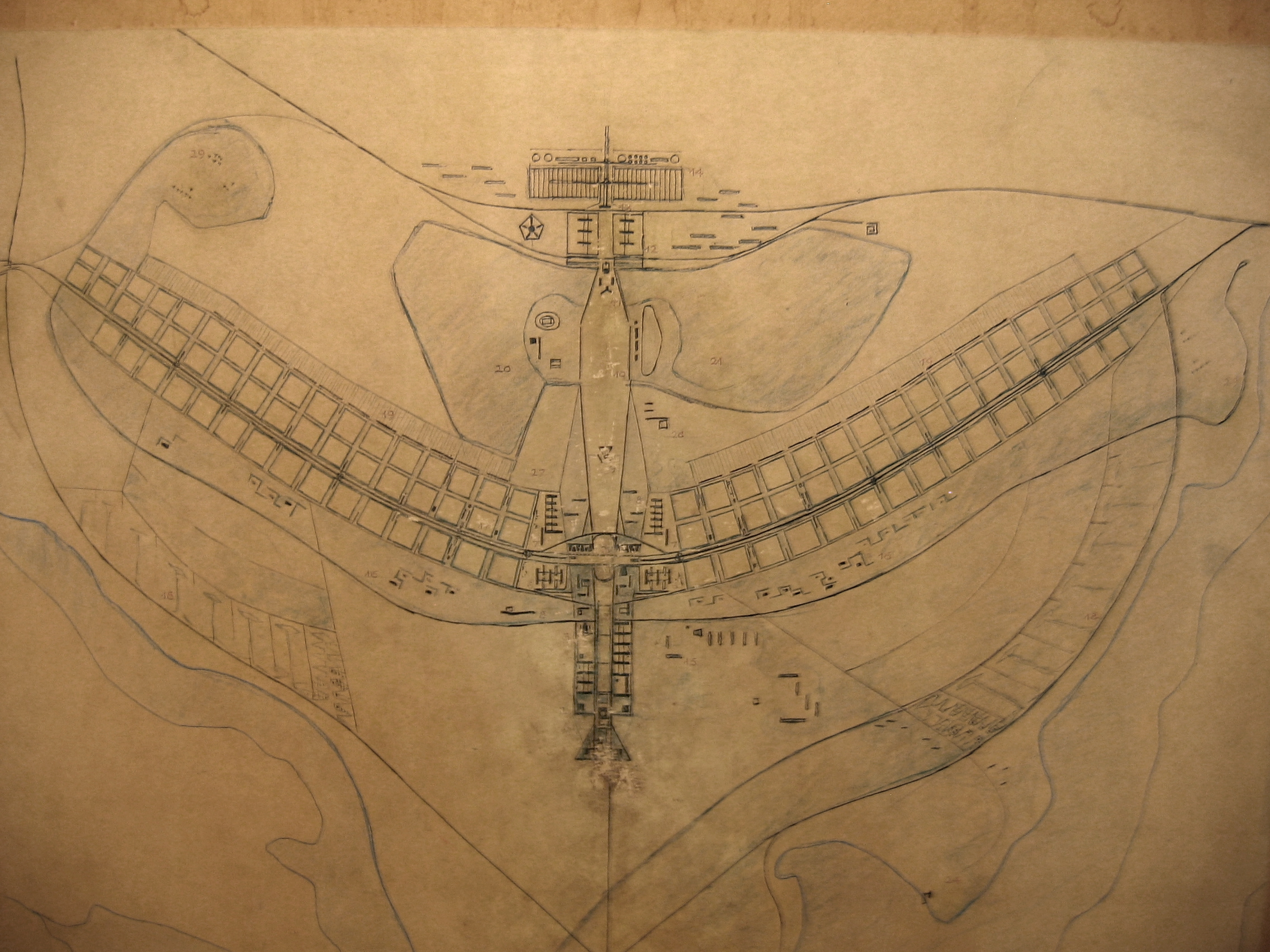
His most devastating case is Brasília. Designed from scratch as the perfect legible capital: functional zones, no street life, no messy commercial districts. A city that works as a diagram and fails as a place to live. The residents immediately built informal settlements around it. The real Brasília, alive and chaotic, full of the qualities the planned city was designed to exclude.
Christopher Alexander saw the same failure from the other side. He wasn’t a political scientist. He was an architect who spent fifty years at war with his own profession.
His question was simpler than Scott’s but pointed at the same wound: why do people love old buildings and hate new ones? Why does a hill town in Italy feel alive in a way that a planned housing development never does? He studied the places that worked: medieval quarters, Japanese farmhouses, vernacular buildings adapted over generations. He found recurring patterns. Spatial configurations that kept appearing wherever people built well.
A Pattern Language catalogs 253 of them. An entrance transition that lets you shift from public to private. Light falling on two sides of a room. An intimacy gradient that moves from open to enclosed as you go deeper into a building. None of these are aesthetic preferences. They’re observable regularities about how humans experience space, discovered by paying attention to what already worked.
The critical move: these patterns are grammar, not script. They don’t give you a blueprint. They give you language for composing your own solution, one that fits your site, your life, your constraints. The pattern tells you cross-lit rooms feel alive. You decide where the windows go.
Here’s where Alexander gets radical. The best buildings and towns in history weren’t designed by architects. They were built by their inhabitants. Generations of people applying shared patterns to specific ground, with feedback loops so tight between use and construction that the structures continuously adapted to actual life. The builder and the inhabitant were the same person. That’s why the hill town feels the way it does.
Alexander called the result “the quality without a name.” You feel it in a well-used kitchen. A workshop that’s been someone’s for twenty years. A messy office where every stack of paper is exactly where it needs to be, illegible to anyone else, a high-resolution instrument for the person who built it. You never feel it in a system designed to be read from above.
Scott and Alexander are diagnosing the same disease from different positions. Scott sees what legibility destroys. Alexander sees what emerges when you stop imposing it. Between them, they frame a bargain that has held for centuries.
The bargain: give up the quality without a name, give up mētis, give up the village, give up the messy office, and in return you get coordination at scale. States, corporations, supply chains. The modern world. The trade was worth it because there was no other way. You could not organize ten thousand people without first making them countable. The village had to become the grid.
What if the bargain is breaking?
Here’s what I keep seeing. Someone on a marketing team spends a Saturday building a tool that monitors competitive activity, pulls from the sources she actually trusts, filters by the signals that matter for her category, and delivers a weekly brief in the format her team thinks in. It runs on her laptop. It cost nothing. It does something the department’s enterprise intelligence platform cannot do, because that platform was built to serve every team in the company at once, which means it serves none of them particularly well.
Her manager will never adopt it. It can’t be audited. It doesn’t feed the dashboard. No one else can log into it and see what’s happening. It is the most useful tool in the department and it is invisible to the organization, because the organization can only see what’s legible. Leadership will renew the six-figure platform contract instead. The platform is slower, more rigid, and less useful. But it’s countable. It has a line in the budget, a vendor relationship, an admin console, a quarterly business review. It can be read from above.
The organization prefers the inferior tool because legibility is the product.
She’s building the informal settlement. She’s building the real Brasília.
Enterprise SaaS is Le Corbusier’s Radiant City built in software. Designed from abstract principles about how users should work, optimized for administrative legibility (dashboards, permissions, audit trails) and hostile to how anyone actually works. People build their real workflows in the gaps. The spreadsheet that shadows the CRM. The Slack channel that replaced the project management tool. The sticky notes that actually run the department. These are Brasília’s informal settlements. They’re where the mētis lives.
This is happening everywhere, quietly, and it undermines the foundational assumption behind every institutional structure we’ve built: that coordination requires legibility. That you have to flatten people into countable categories to get anything done at scale.
What changes when the inhabitants can build their own city? When the person who needs the tool builds the tool? The feedback loops Alexander identified, builder and inhabitant as the same person, become possible for software, for analysis, for entire workflows. You don’t need to measure board-feet if the forest regenerates overnight.
The village at scale. That’s what’s emerging. Rigorous in the way Alexander’s pattern language is rigorous, shaped by use, adapted to ground. Illegible from the center. Alive at the edges. And it’s emerging whether institutions adopt it or not, because the people doing the work aren’t waiting for permission. They’re already building in the gaps, the way Brasília’s residents always have.
Most institutions will keep renewing the platform contract. Keep optimizing the monoculture. Keep watching the metrics hold steady while the forest dies underneath them.
The village doesn’t wait. It’s already being built, one messy office at a time.